"Drawings can be representational or abstract, contain narrative content and symbolism, and communicate emotional, spiritual, political or philosophical ideas."
Department of Art and Art History, Washington, http://art.georgetown.edu/drawing
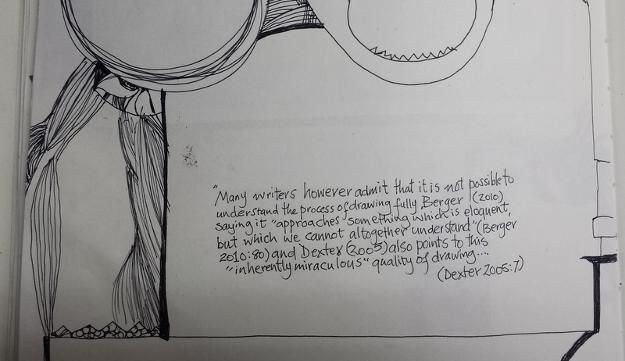
“Many writers however admit that it is not possible to understand the process of drawing fully, Berger (2010) saying it “approaches something which is eloquent, but which we cannot altogether understand” (Berger 2010:80) and Dexter (2005) also points to this “inherently miraculous” quality of drawing…..(Dexter 2005:7);…”
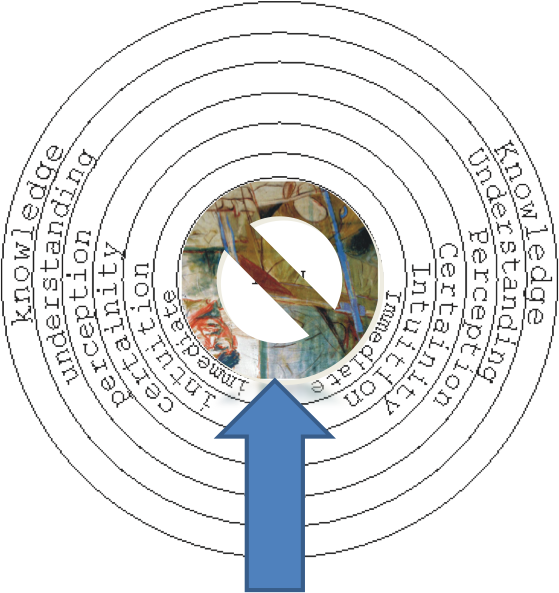
I found my work trapped in ‘Immediate,’ ‘Intuition’ and ‘Certainty,’ though there was some sort of ‘Perception’ in it, but what about the ‘Understanding’ and ‘Knowledge’ as per Hegelian dialectics? What choice do I have then? I have no choice but to start…. Start right from 'HERE'... where 'I Exist' and where 'I AM'…. From ‘Today’ And 'Now’ to the ‘Future.’ Can I then call it ‘Drawing Future’ or ‘’Now FUTURE’’? May be Not 'Now'… But that’s where it will lead to!!!
Conclusion:
Constructing Meanings in Autography is an outcome of my research in drawing practice. I started my research in practice with an aim to rediscover drawing in general and my own drawing practice in particular, its methods and meanings. Through initial learning at The School of Art about methodologies, I discovered the notion of Schon’s Reflective Practitioner. When I started this process, I thought at the end I would come up with a final outcome. But on my way of practicing the chosen methodology, I realised this is not like an ordinary one-off project, but rather it is a mode of practice, i.e., an on-going process and cannot just be started and finished in a limited time period, especially when the art will be continuously practiced later.
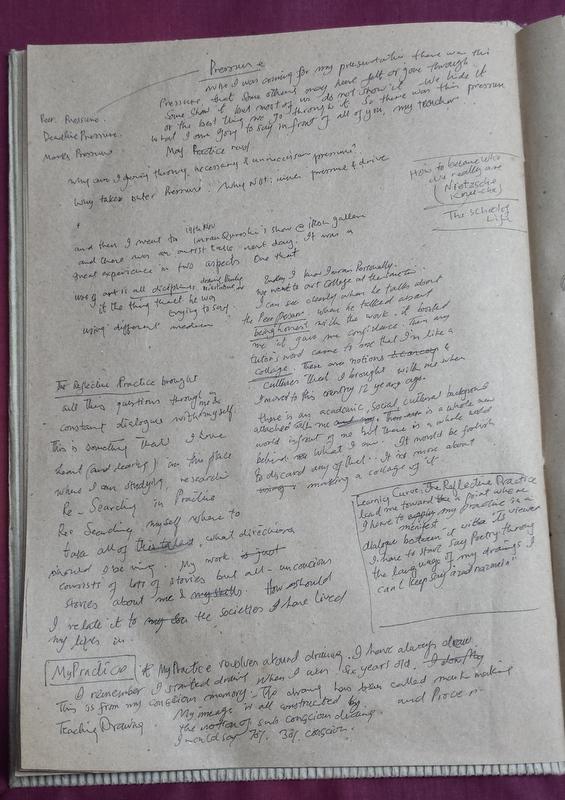
After consciously practicing art as a reflective practitioner, the initial findings in my work were remarkable for myself. First of all, I practically found that a formal method exists that can help me to move forward in tricky situations. After setting up a task to do a series of drawings to find out my practice process, I was surprised to find the results in my first two experimental works; the reflections enabled me to rethink about my practice process. It was very surprising because I ‘Knew’ it before but never ‘Realised’ it in practice. It also made me realise practitioners (or at least myself) apply “knowing in” reflection unconsciously in daily practice but may be only a few artists make “knowing on” a formal part of their art practices. But at the same time I was not satisfied as I felt something was not right. Will I just keep creating and writing about it? How long will I be able to carry on like this? It was great, but I was confused if I should continue like this for my third piece of set task. I then referred back to Gray and my notes on Reflective Practice as I remembered we were told something about the reflective questions in one of the seminars at university. Soon I realised that again, like my art practice, I was doing the reflecting more organically. I realised I should make it more formal. The suggestive questions by Schon & Gray were the answers. My third and fourth artwork turned out to be even more powerful for my own sake, as I was challenging myself in the mirror through organised questions about my work. It was all about questioning oneself, not casually but in a more formal and structured way. Just like looking into a mirror at ourselves and finding out what needs to be done. And it is not just about beautification but using the mirror to observe and correct everything thoroughly. ‘I look fine,’ sometimes we say it ourselves without looking into a mirror. Was I practicing art in the same fashion previously? I realised I was not, because in practice, we are continuously looking at our work outside of ourselves. But deep inside I knew that it was not fully true. We get less critical of ourselves and of our work. Just as we think our speech is fine, but when we hear ourselves in an audio recording, we usually do not like our own voices. Hearing one's own voice like that as a third person is an easy-to-understand example of the difference between ‘knowing-in’ and ‘knowing-on’. And this approach helped me in becoming a ‘conscious being’ in my art practice. All of this was realised during my research in practice and is one of the major outcomes of this module. While organising my work tasks, I came to know about 'reflective cycles;' while talking to peers and through tutorials, I found about reflective journals and readings on contemporary drawing and especially the methodology of reflective practice. This has helped me in developing new understanding of a conscious dialogue with the artist (myself). It has especially helped to speed up the process that one would do maybe in months or years through informal actions.
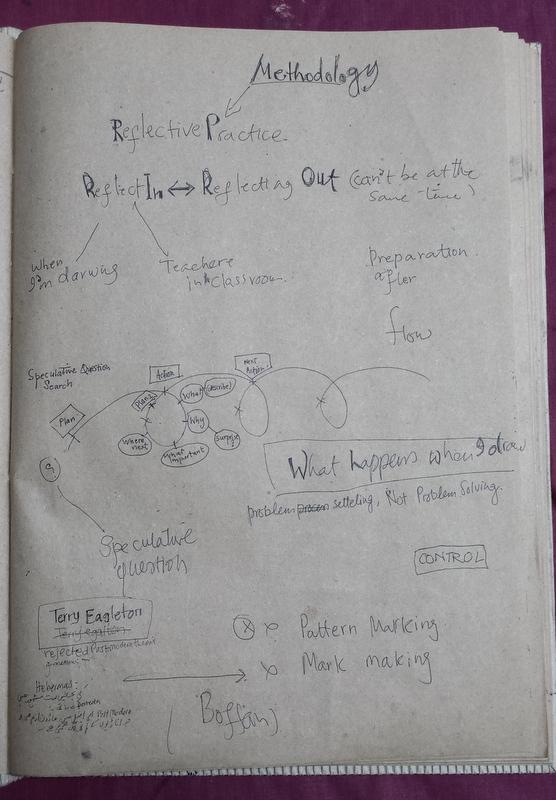
Although it was a very short time period to explore various dimensions of the methodology,I have found that the methodology in its core is strong enough to change anyone’s perspective and can be good to test and adapt in art practice. That is why I decided to continue using it in my future practice. It is especially beneficial when an artist gets stuck or needs to think, rethink, break into, and explore new ideas. For this reason, the RiP module has now become my new favourite in my MA education. I have been practicing drawing for a very long time, but after a certain point, my work was unable to take me on a new journey. The main aim for this research was to enable me to resolve it. Through reflective methodology of 'do, reflect, summarise, test' (Kolb 1984), I have not merely found the key to moving forward but rather realised the importance of Reflecting in/on/for Creating. It is a new position as compared to my previous work approach. I realised that in my previous work, some informal and intuitive reflection existed, but there was a lack of formal reflection-on-action. In the last term, I was emphasising Creating art more organically, but in recent months I have learned the important difference of reflecting-in-action and reflecting-on-action. I am glad I was guided in the right direction. This unlocking-the-path has given me new ideas to work upon my original perspective. Some of these I have tried and tested as experiments, and they can be seen on this webpage. Apart from Schon and Gray’s theories, other post-modern writings on drawing like Tracey, Drawing Now, Vitamin D and contemporary artists like Jonathan Houlding and Bronwyn Platten have helped me to appreciate contemporary drawing practices in more understandable and meaningful ways.
The weakest point has been the time constraint as it would be in any research of this kind. Although I have completed my recent research to a point of submission, I thought for my own learning, it is not sufficient to start and finish this journey within a short span of time. I started research in practice without realising that this initial investigation can itself become a part of my future art practice. I understand by continuing Reflection on Practice, my art practice will become more challenging, and it will make the task lengthier. At the same time I believe it will make my work more insightful, not only from my own point of view but from viewers’ point of reference too. In short, I decided that I would continue my Research in Practice, and it will turn into Reflection on Practice. For this, I aim to continue developing my website. In regards to art practice, I have also found through experiments that with this methodology a real development in initiating dialogues can take place in my work. The strongest point so far has been my learning curve in resolving complex issues through critical thinking by myself. This might seem obvious, but I am approaching it with a stress on the reflective practitioner with a contextual mindset. I have discovered how certain ideas can be redefined and reshaped. Lastly, in regards to art education, an opportunity has arisen for me to continue teaching creative drawing in a local private environment. And I believe this research will be equally helpful in my role as a drawing coach.
This research has contributed a lot to my thought process and has opened windows to explore new possibilities. It has certainly added new dimensions to my understanding of contemporary drawing. I had heard the terms of Autograph and Autobiography and understand what these actually entail. But I have borrowed the word and have tried to give ‘Autography’ new meanings through my practice. I am not completely sure if it has been used before in such a context.
In the past, I learnt about the idea of drawings being a small window to one's individuality. But I have discovered about reshaping and redefining from what is already there. I have tried to sum up my recent reflective journey in this website. As I mentioned, I have decided to continue developing this as I progress further and take it along as part of my art practice. Please look through the pages, and if you have any questions, I will be ready to answer them.
In the end, I would like to thank all of my teachers who have helped me in this process and opened doors to set me free. In the last few months, it has been a wonderful and exciting journey to work as a reflective practitioner, and I will continue to explore and develop it in my future art practice, especially in coming months, to explore its potential further. I am hopeful it will play a positive role in my future art practice, and I may be able to contribute through sharing and educating about it through my experiences.
“The current resurgence in drawing in recent years is perhaps the first moment in history when artists can opt for drawing as their principle medium, confident in the knowledge it will not suffer in status as a result”
(Emma Dexter, Vitamin D: New Perspective in drawing, 2005, p8)
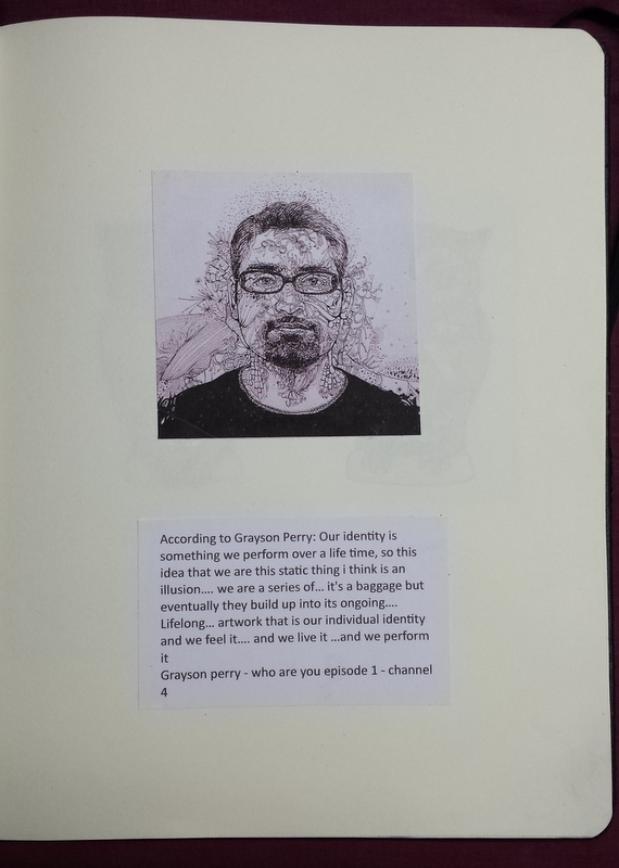
"Our identity is something we perform over a life time, so this idea that we are this static thing, i think is an illusion... we are a series of... it's a baggage but eventually they build up into its ongoing lifelong artwork that is our individual identity and we feel it and we live it and we perform it."
Grayson perry, Who Are You. Episode 1, Channel 4, 2014
