The Autographic Prayers
(Sajda-e-Giraa'n) سجدہٗ گراں
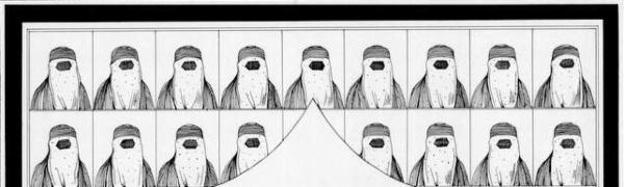
'The Autographic Prayers' is a series of works that embody reflections that took root back in my childhood in Pakistan. This series represents the final stage of my artistic research at Birmingham School of Art, where my creative methodology has shifted towards a more self-critical approach. As I have been compelled to reflect systematically on my practice, I shifted my interest from automatic drawings to ‘autographic’ drawings. The automatic drawings that I displayed in my previous show were based more on the surrealists’ subconscious mind and were more random in nature. The coined term 'autographic drawing' does not deal with the subconscious as much as it deals with my memory and identity; and the outcome is based on planned visual interpretations from my personal experiences. I have redefined this process as ‘Autography’ in drawing practice. This process led me to the idea of “Autographic Prayers’ that I narrowed down from a variety of possibilities. Originally, I planned to draw a similar series of praying mats by using the psychological phenomenon of Pareidolia in which one allows mind to perceive familiar patterns on visual surfaces. Later and more recent developments have made my query more intriguing with the possibility of looking into the notion of ritualised praying and its visual metaphors. Since childhood it had been near impossible to keep my imagination from seeing images in the abstract decorations that characterise these praying mats. Now I am turning my imagination back to these mats but with the deliberate intent to present images. These images work as visual metaphors and aim to set a critique in regard to hypocritical contradictions in some acts of ritualised praying that exists within my community.
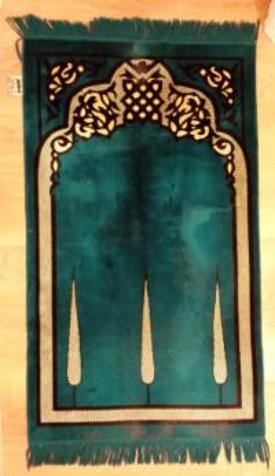
A praying mat characterises the home of any practising Muslim. Children and adults alike use praying mats for their daily prayers. Usually a small piece of rug is used as a sacred household object. Although there is no set or strict pattern, generally a praying mat is meant to be very simple. On the contrary, usually these mats are visually busy, colourful, or sometimes heavily decorated. In Islam, the image of a living thing is forbidden in a place of worship. This belief got extended so much that it was considered that the image of any living thing is completely forbidden anywhere at all. This distortion in religious narrative made the situation very confusing. I remember as a child I had gone through this 'frictional' phase when my heart told me to draw portraits and my mind would contradict through orthodox religious connotation from my surroundings. The whole idea of becoming an artist was more complicated in my case, because I was interested in drawing human faces. For two to three years of my adolescence, I questioned my identity of a Muslim about drawing images and becoming a practising artist. Out of curiosity, I listened to many religious interpretations and kept drawing at the same time. I remember, as a child, while praying on those mats, I used to spot images in the heavily decorated borders. The identical decorative pattern on right and left of a carpet would sometimes make it look like two staring eyes looking back at me. And I used to get lost into those patterns and start drawing shapes in my head while standing on the mat and praying at the same time. I also remember that due to this contradiction, I used to look for plain mats, as I could not stop myself from spotting images.
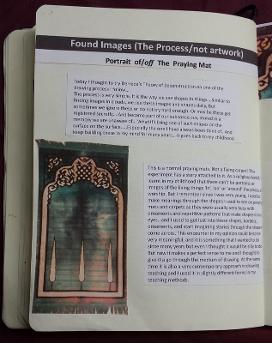
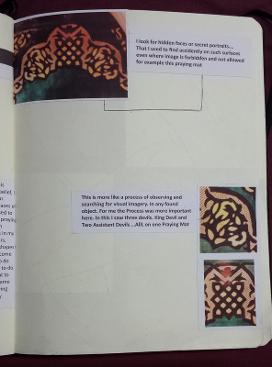
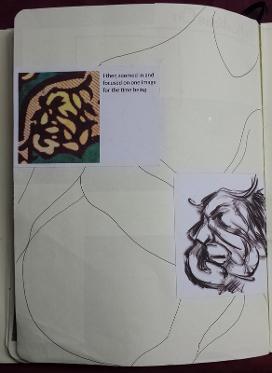
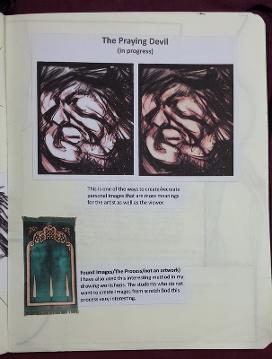
During my research in practice, I recalled those aspects of Pareidolia, and developed an experimental drawing 'The Praying Devil’ from a mat. Sharing the process in the college seminar presentation opened up further aspects, and it led me to finalise my practice ideas. I got more focussed in digging deeper and exploring further into the whole idea of ritualised 'Prayer,' rather than just spotting images in existing patterns. Thinking about those staring eyes, I imagined: what if the praying mats could reflect back people’s prayers and take visual forms? What contradictory symbols a person might possibly see according to his or her prayers? Visualising the relationship between the Prayer and The Praying Mat, started to raise questions: What does a ‘Prayer’ really mean to a particular 'Person'? How does it manifest in his real life? How does it affect others' lives? If 'the function of prayer is to change the nature of the one who prays.' as Kierkegaard sustains;1 what change in nature can we see? The art practice initiated a dialogue by raising similar questions, and I continued to look for visual answers for my work. It subverted the original purpose of the mat, which did not relate to the functionality of it. And it resulted in autographic interpretations of these 'different' prayers.
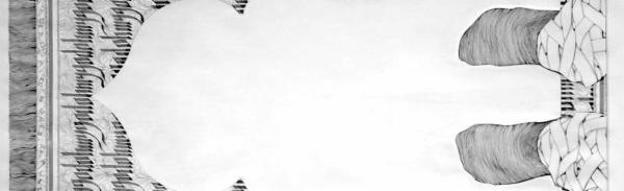
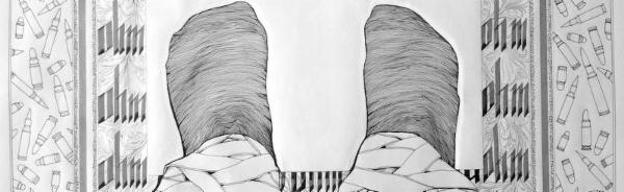
'A praying artist' may be a soft example, so I started with an extreme case. For example, how can someone who glorifies himself as a religious person and offers prayers five times a day, take innocent lives at the same time? What praying experience is he actually going through? What visuals is he perceiving on these mats? Or what metaphors does such a praying mat reflect? Then I recalled the experience of being in a religious space, and I remembered when I came across some known corrupt individuals who were praying on the praying mats with satisfied faces..., and in 're-contextualising,' all I could conceive through my imaginative eyes was a jewel-like praying mat in their eminently ‘decorative’ prayers. The prayer mat reflected nothing but a display of wealth. A similar duplicity is envisaged in a separate piece through the prayers of a hypocritical male chauvinist who ironically sees women as ‘the shoe of the man’s f00t’ yet always has women on his mind.
I found it was not just the orthodox religious narrative that causes the problem, but it becomes more dangerous when a religious connotation is combined with a cultural falsification. Or when religion is used for indoctrination or for political motives. A praying mat can result in becoming a tool, to let a believer feel very self-content, as a highly moral being as compared to those who do not pray. It creates a sense of moral superiority in such cases instead of a personal act of worship. Such ‘Prayer’ gives birth to arrogance instead of humility or humbleness. Most of the time it is practised as a ritual without even realising what is being said, and the ineffective prayers become merely acts of desires and wishes.
In my observation, the conflict in thoughts usually takes place on borders or on extreme ends. The centre is more likely a safe place, peaceful and calm. A contradiction prevails when we go to extreme ends. But, on one extreme, there exists this similar ‘other’s’ extreme, also ready for a conflict. In drawing, I have tried to grasp this phenomenon of extremism by working on the border areas of these praying mats. The centre, where one usually focuses in viewing an artwork, is seen as an empty untouched blank space, which becomes unapproachable from all of its sides due to these busy conflicting borders of extremes. It really matters what one is taking to the praying mat, the act of praying changes shapes according to the individual’s aims, ambitions, intentions, and religions. People can be very selfish in their dealings with others; they can cheat and pray at the same time, to justify their unlawful behaviours as if the act of prayer will do the magic to purify their dark sides. Such an act of ‘Prayer’ becomes an act of self-righteousness or self-fulfilment. In a constructed reality, this praying carpet loses its strength of sacredness and becomes an inconsequential flimsy piece of material, belying the fragility of the man’s intentions.
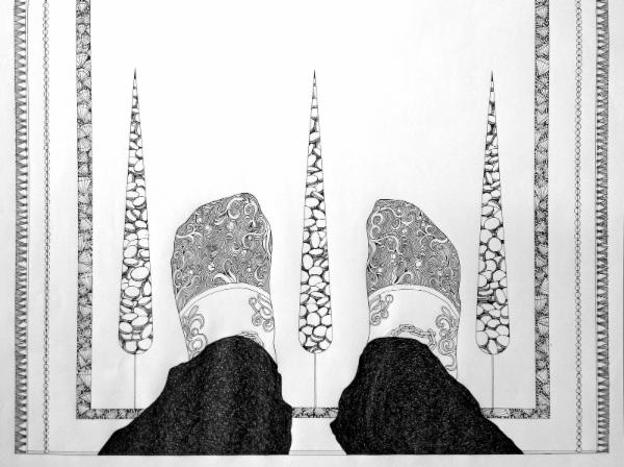
In a multi-cultural society, co-existence of multi-faiths is becoming a contemporary challenge, and is echoed repeatedly in the media. As a British-Pakistani artist, my opinion about religious extremism is that educating in an intelligent way to ‘kill the distorted religious narrative’ can be more effective and conducive than to tackle it through strong legislation or confrontation. A generation of a few vulnerable individuals were taught a narrative of ‘killing in the name of religion.’ This threatening narrative needs to be condemned first from within by a counter narrative and then wiped off The Praying Mats. Brushing issues under the mat from one side or rolling back the carpet from the other will not help in integration. Making the dark and busy mat clear and simple can greatly help solve a serious issue of human lives. Each destructive incident adds more insecurity, due to the wrongful acts, wishes, and prayers of others. I have tried to augment these contemplative issues using my drawings with an intention that it may initiate a discourse with the viewers.
'Philosophy is perfectly right in saying that life must be understood backward. But then one forgets the other clause—that it must be lived forward.' 2 Life exists with a baggage of multiple realities, and individuals have their own interpretations of identity. Identities and realities can get 'misconceptualised.' Without a detachment from my existing identities, I have tried to construct, through my art practice, those invisible realities we feel but sometimes we do not see. I have experienced and lived in different cultures, and as an artist, I feel responsible after observing two societies critically from the outside as well as from the inside. My current identity as a British Pakistani artist has enabled me to see both cultures more objectively. This perspective of my identity compels me to mediate or bridge gaps between communities through my art practice and education.
It may or may not take a while to achieve something 'significant' as an art teacher or as an 'artist in the classroom.' But after this MA, I feel well prepared and confident. Since last year, I found a regular opportunity of being a drawing coach to mixed-age adult groups at a local independent art institute. Where I am able to share my 'new' knowledge about drawing, and I have managed to introduce new practice techniques that I have discovered myself recently, especially the ones that were more relevant to the particular age groups, I realised it is really important even for a beginner in a drawing class to know multiple meanings of 'drawing' and its furthest possibilities to construct new meanings in a contemporary art scene. It is to lay a foundation in the 'basic' understanding of the subject and help an individual to contextualise oneself accordingly. In the meanwhile, I have also started my own private drawing workshops that I am targeting to expand further after finishing this course. In these workshops, I am providing one-to-one art coaching and art sessions to small groups within my own little studio. The core as well as the optional modules that I have taken during my art practice and education course have been a great help in this regard. The whole experience has catalysed my attention on the importance of self-critical reflection in creative practice. Now I feel that I have better tools to develop my research autonomously on a conceptual level. These achievements are already having a beneficial impact, when it’s my turn to teach. It has been a privilege to be at the school of art and to learn from the brilliant mentors of BCU. This has been an unique opportunity, which has supported me in developing new strands in my art practice.
-----------------------------------------------------------------------------------------------------------------------------------------
1. Søren Kierkegaard, 'Remorse, Repentance, Confession: Eternity's Emissaries to Man,' Purity of Heart Is to Will One Thing, The Wisdom of Kierkegaard, Vol. I (Radford, VA : Wilder Publications, 2008), 106.2. Hong, Howard V., and Edna H. Hong. The essential Kierkegaard. (Princeton, Princeton University Press, 1997) 12.
Bibliography
Alphen, V. E. Looking at Drawings, in Steve Garner (ed), Writing on Drawing; Essays on drawing, practice, and research. Bristol, Intellect Books, 2008.
Berger, J. Berger on Drawing. Cork, Ireland, Occasional Press, 2010.
Carole, Gray, and Julian Malins. Visualizing Research. Aldershot, Ashgate, 2004.
Davidson, M. Contemporary Drawing. New York, Random House, 2011.
Dexter, E. Vitamin D2: New Perspectives in Drawing. London, Phaidon Press, 2013.
Dexter, E. Vitamin D: New Perspectives in Drawing. London, Phaidon Press, 2005.
Donald, A. Schon. The Reflective Practitioner, How Professionals Think in Action. London, Maurice Temple Smith Ltd, 1983.
Downs, Marshal, Selby Sawdon. and Tormey. Tracey Drawing Now. London, I.B.Tauris, 2007.
Elkin, James. On the Strange Place of Religion in Contemporary Art. London & New York, Routledge, 2004.
Hoptman, L. Drawing Now: Eight Propositions, catalogue. The Museum of Modern Art (MoMA), 2002.
Hong, Howard V., and Edna H. Hong. The essential Kierkegaard. Princeton, Princeton University Press, 1997.
Ineke, de Feijter. The Art of Dialogue: Religion, Communication and Global Media Culture. Lit Verlag, Germany, 2008.
Jones, Amelia. Seeing Differently: A History and Theory Identification and the Visual Arts. New York, Routledge, 2012.
Lyons, Deborah. Edward Hopper: A Journal of His Work. NY & London, W W Norton & Co, 1997.
MacClancy, Jeremy. Contesting Art: Art, Politics and Identity in the Modern World. Bloomsbury Academic, London, 1997.
Maclagan, David. Line Let Loose, Scribbling, Doodling and Automatic Drawing. London, Reaktion Books, 2014.
Platten, Bronwyn. Mouths And Meaning Workshop1. Manchester, The University of Salford, 2012.
Rose, B. Allegories of Modernism: Contemporary Drawing. New York, MoMA, 1992.
Kierkegaard, Søren. The Wisdom of Kierkegaard, Vol. I. Radford VA, Wilder Publications, 2008.
Weintraub, L. Making Contemporary Art: How today’s artist think and work. London, Thames and Hudson, 2003.
-------------------------------------------------------------------------------------------------------------------------
A Line Drawn from the Eye to the Summit - MA Show - September 2015,
Jamal Mustafa, MA - Art Practice and Education - The School of Art, Margaret Street, Birmingham, UK
